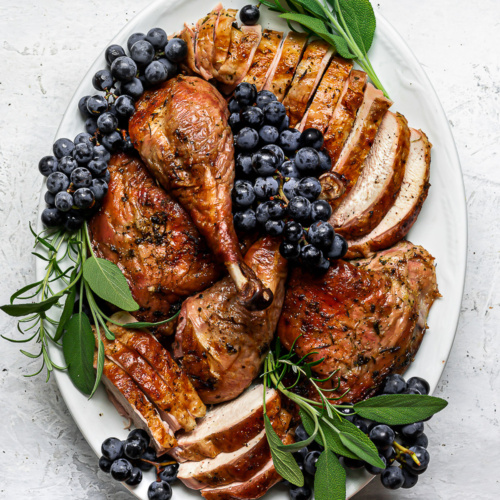
Spatchcock Turkey with Dry Brine
sandravalvassori.com
This Spatchcock Turkey with Dry brine offers a life-changing, reliable, easy, and foolproof method to achieve the crispiest, juiciest turkey in the least amount of time. Read on to learn all the tips and tricks to pull it off with ease. At first glance, the instructions may appear long and complicated for this spatchcocked turkey. I assure you it is all very simple - I have just included a lot of tips to ensure you have fabulous results with your turkey.
Servings: 8 to 10
Ingredients
- 1 (12 to 14) pound fresh turkey natural whole turkey
For the dry brine
- 4 tablespoons Kosher salt (or 1 1/2 tablespoon per 5 pounds) I use Diamond Crystal (see notes)
- 1/3 cup of mixed fresh herb leaves and tender stems, such as thyme, rosemary, and sage
To Roast the Turkey
- 2 cups chopped vegetables such as onion, carrots, celery, or fennel (optional)
- 6 Tablespoons melted unsalted butter or unrefined olive oil
- freshly cracked black pepper to taste
- 2 cups water, no-salt chicken stock, or wine, or a mix of all three, plus more if needed
Instructions
Spatchcock The Turkey
- Remove the neck and giblets from inside the turkey. On a large cutting board or baking sheet, place the turkey breast-side down so the backbone is facing up. Using a pair of poultry shears or sharp kitchen shears, cut down each side of the backbone, cutting all the way through to remove the backbone completely. Save the backbone and giblets to make stock, if you wish (you can make the gravy a day or two ahead from roasting the turkey).
- Cut a small incision on the cartilage that is between the two breast bone. Now flip the turkey breast-side up and press hard on the breast to break the rib cage bone to flatten the breast even further.
- TIP: If you can order a spatchcocked turkey from a butcher, do it! Be sure to ask for the backbone that was removed to use it to make stock.
Dry Brine The Turkey
- Combine salt and fresh herbs in a food processor or mini chopper; process until herbs are finely chopped.
- Place the flattened turkey, breast side-up, on a large sheet pan to apply dry brine. Pat dry the turkey inside and out with paper towels. Sprinkle the salt mixture evenly all over the outside and the underside of the turkey. Loosely cover with plastic wrap and place in the fridge for 1-3 days. 12-24 hours before you plan on roasting the bird, remove the plastic wrap and leave uncovered in the fridge.
- TIP: If you can't fit a large baking sheet in the fridge, place the turkey in a large bowl.
Prepare Sheet Pan
- If using, scatter onions, carrots, and celery across the bottom of a large sheet pan. Place wire rack directly on top of vegetables.
- TIP: A spatchcocked turkey will roast best on a shallow baking sheet fitted with a wire rack. If you don't have one, use the shallowest baking pan you have and fill it with large chunks of vegetables such as carrots, onions and celery. Place the turkey on top of the vegetables.
Prepare The Turkey And Oven For Roasting
- Take turkey out of the fridge 60-90 minutes before you plan to roast it.
- A half hour before the turkey is ready to roast, adjust an oven rack to middle position and preheat the oven to 450ºF (230ºC). A large oven will take about 25-30 minutes to preheat.
- Once the turkey has come to room temperature, and the oven is preheated, place the turkey on prepared sheet pan, breast-side up. Arrange the turkey so it fits inside the pan as much as possible, then tuck the wing tips under and turn the legs out. Brush the turkey all over with the melted butter. Sprinkle with freshly cracked black pepper to taste.
- TIP: If the legs are hanging over the edge of the pan, consider placing a piece of aluminum underneath the pan to catch any drippings.
Roast The Turkey
- Place the turkey in the oven and pour 2 cups of liquid (water, broth, wine or a mix) in the pan. Roast at 450° F for 30 minutes. Carefully rotate the pan, and add a bit more water if necesary, then lower the temperature to 400°.
- Continuing roasting until the internal temperature of the thickest part of the thigh reaches 165ºF and the breast 155ºF degrees. A 14-pound turkey will take about 90-95 minutes total. A 12-pound turkey may only need 80-85 minutes so start checking early. If the turkey is browning too qucikly, just cover loosely with foil. Add more water or broth if the pan drippings are burning.
- TIP: Add more water or broth if the pan drippings are burning.
Rest the Turkey
- Remove the turkey from the oven, transfer it to a cutting board, and tent with foil. Allow it to rest for at least 30 minutes before carving (45 minutes is even better). Do not rush the resting period, this step is crucial for a juicy, perfectly cooked turkey.
- TIP: Strain the pan drippings into a heat-safe container, lightly pressing on the veggies to extract as much as possible. Set aside to make gravy (recipe in notes).
Notes
Salt - You want to use a coarse salt, such as kosher salt, for dry brining. But keep in mind the larger the grains in Kosher salt the harder they are to control when applying to your food. Diamond crystal kosher salt has smaller granules than other kosher salts and therefore is less salty. If using a different brand with larger granules, such as Morton or Windsor, reduce the amount of salt by 1/2 a teaspoon per 5 pounds. I do not recommend table salt for dry brining.
Pro Tips For The Best Spatchcocked Turkey
-
- Read over the recipe once or twice. Though the steps to roasting a spatchcocked turkey are simple, there is a lot of information and tips. Read over the recipe instructions and notes a few times to become a bit familiar with the whole method. The step-by-step photos provided in the post are also very helpful.
-
- Season simply. Because the spatchcocked turkey will roast at a high temperature, you want to keep the seasoning simple. Minced garlic, dijon marinades, etc, will burn too quickly. I added fresh herbs to the dry brine but even that is not necessary. Butter, salt, and pepper add plenty of flavor and gorgeous color to the turkey.
-
- Use a meat thermometer. You cannot guess the temperature on this one. Use a reliable meat thermometer to ensure you don't over cook or under cook the turkey. An instant read thermometer such as this one, works great. When inserting the thermometer into the meat, make sure it is not touching the bone to get an accurate reading.
-
- Add more water to roasting pan. To prevent pan drippings from burning, feel free to add more water or chicken broth to the pan.
-
- Sharpen your knife for carving. If you have the time to get your knives professionally sharpened, this would be a great time to do it. It makes the job of carving the turkey a breeze.
- Depending on how hot your oven runs, and how big or small your turkey is, you may need more or less roasting time. Start checking the temperature after 75 minutes to gauge how much longer the turkey needs to roast.
- A spatchcocked turkey is best cooked at a high temperature. If your oven is really hot (mine isn't) you can lower the temperature to 375 degrees after 30 minutes.
- If roasting two turkeys at once, set the oven to convection cooking, if possible. But be sure to reduce all temperatures by 25 degrees for convection.
- 3 tablespoons butter
- 2 1/2 tablespoons flour
- 3 cups homemade turkey stock, or store-bought chicken broth
- Turkey drippings
- Freshly ground black pepper
- Kosher salt (the turkey drippings will be salty so add only if needed)
- In a medium saucepan, melt the butter over medium heat. Whisk in the flour and cook, stirring constantly, until lightly golden, about 2 minutes.
- Slowly whisk in turkey stock or broth and all the reserved turkey drippings. Continue to whisk until smooth. Simmer, whisking occasionally about 5-10 minutes, or until desired thickness is achieved.
- Season to taste with pepper and add a little salt only if needed. Gravy can be stored in the fridge, tightly covered, for up to 4 days. Reheat over low heat until warm, whisking occasionally.